Pages

Showing posts with label love stories. Show all posts

Tuesday, 14 February 2012

Love

...because I've had far too little sleep to be able to think of a cleverer title!

Happy Valentine's Day, bloggers and readers! It's the official day of romance, and roses, and other things beginning with R (okay, so I couldn't think of a third. Did you not see the part about the lack of sleep?) and though I personally think every day should be about romance, roses and R-things, today seems a particularly good time to talk about love stories.

So here are a few of my favourite romantic/love-filled/similarly-themed books-

1. Me Before You by Jojo Moyes
Unadventurous Lou becomes crippled Will's carer and everything changes. This is lovely. And it's a bawl-fest.

2. Millie's Fling by Jill Mansell
A summer by the seaside. A girl who likes a boy. A boy who doesn't want to like the girl. Fun, funny and sweet.

3. Frenchman's Creek by Daphne du Maurier
Bored, beautiful Donna meets a French pirate on the shore of a lonely Cornwall creek. This is passionate and heartbreaking and beautifully written. Love, love, love this one.

4. Shiver by Maggie Stiefvater
Boy meets girl. Except boy turns into a wolf when it gets too cold. Sweet, exciting, glorious. Many tears were shed. 
                   
5. Forbidden by Tabitha Suzuma
Boy meets girl. Except they don't quite 'meet' because they've known each other all their lives. They also happen to be brother and sister. It's controversial. But so wonderfully written, so wrenching, so amazing.

What are your favourite love stories?

Wednesday, 15 June 2011

There's something about The Boy

Or man, as the case may be. I realize this post might largely be to the tastes of my female readers, but it's something I thought worth writing about. The male protagonist/hero/love interest is such a key part of most novels. In fact, I don't know about you, but sometimes I'll read - and reread - a book just because I love The Boy (or man) so much.

Maybe we like to step into the shoes of the female narrator/protagonist and imagine he's in love with us. It's all part of the escapism of reading. Or maybe we think he reminds us of someone we fancy/love in real life. Whatever the reason, whatever the genre, I've found that The Boy can have the power to make or break a story.

So how do you create a swoon-worthy love interest type?

Make him devoted. He can be the witty, charming, sweet, sarcastic, rude, ambiguous, openly loving, any of those things. But as long as we know, deep down, that he would pretty much do anything for our heroine, we're hooked. There's something irresistible about someone who sticks by no matter what. 

But don't make him a doormat. Unfortunately, you can take this too far. He can become a whining, snivelling, 'yes darling of course I will' type and then you just want to smack him (and her, for letting him carry on like this). I'm going to mention Edward from the Twilight series here. His devotion to Bella is touching. But there was something immensely annoying about his behaviour in Eclipse: notably the way he was willing to stand by and let her snog the Other Boy right in front of him just because. Devotion can go too far. It can make a character look pathetic.  

Make him amazing in some way. Is he a really powerful warlock/vampire/werewolf/businessman? Does he have super-strength or speed? Is he just really smart? Make him almost unsurpassed in some way. It's attractive. 

But for the love of Heathcliff, make him flawed too. Perfect characters are a pet peeve of mine. I hate them. I think an awful lot of other people hate them too. No one likes a character who can do anything, achieve everything, be totally awesome and never have to deal with a single consequence or ever suffer a moment of true conflict. Flawed characters are incredible. We understand their flaws because we're flawed too. These flaws can be huge things that the character can't get past or they can be small niggles, realistic things that crop up now and then. We can love these characters because they're not alarmingly, intimidatingly, irritatingly perfect. 

Make him a little bit of a bad boy. This one is completely take-it-or-leave-it. But ladies, let's face it. We're drawn to the slightly dangerous, wise-cracking types in fiction, aren't we?  

But he'd better have a heart of gold under all that badass-ness. Because in the end, we want our heroines to end up with the nice guy. The one who deserves her. (Unless we hate her, in which case we just want someone to strangle her, but that's a whole other problem.) It also satisfies us because we're in her shoes. We want to end up with the nice guy too.

Well, there you have it. I've searched my bookshelf, unearthed beloved male characters, analyzed them to death, and boiled it all down to the above. When you create your bestselling love interest and fangirls the world over are tattooing his name to their bosoms, you know who to thank!

What draws you to a fictional man? Who are your favourite love interests? And to the male readers: don't be afraid to chip in with your take on the female side too - I'm intrigued to know what kinds of female characters hook you?

Wednesday, 16 February 2011

Ah, St Valentine


If you think about it, few 'holidays' are as controversial as Valentine's Day. After all, you don't see many people calling Christmas 'cheesy' or getting seriously worked up over the pros and cons of Diwali? My own mother thinks Valentine's Day is incredibly cheesy, while my husband has no problem using the opportunity to be romantic and do something special. Vastly different viewpoints there.

In fact, growing up in India, you heard a lot of unusual things about Valentine's Day. So, here, your Valentine's Fact of the Year:

There was a story going around when I was younger, about members of a very right-wing group who were so opposed to the moral degradation Valentine's Day obviously represents that they went around beating up couples who were caught hugging, kissing or - heaven forbid - holding hands in public.

The cool thing about it, though, was that apparently one year a group of volunteers banded together and actually went around protecting the couples on Valentine's Day. Like, you know. Beating up the bullies.

I enjoy that part of the story very much.

Romance in fiction can be just as controversial, as any member of the Edward/Bella/Jacob Twilight love battle will tell you. And I think it can get people so worked up simply because it matters so much to us. I don't know about you, but relationships in fiction, when done well, fascinate me. Any kind of relationship, it doesn't necessarily have to be romantic (though I do have a special soft spot for those!)

So I try to remember that every time I write. Character relationships matter. Without them, a story feels flat and hollow.

And as a final note on the theme of love, romance and relationships, here are a few wedding photos - at last!

 That's us, unable to keep straight faces as we sign the register. So much for great solemnity on the occasion!

After the ceremony. My smile looks a little manic, but it's probably because I'd been smiling non-stop for photos for the last half hour.


That's me with my bridesmaids. You probably can't tell from this photo, but literally seconds before the camera clicked, we were all squealing because Lindsey (the blonde one) had just stepped on an enormous earthworm.

And that was my wedding. Well, more or less. I don't think Blogger would cope with all the photos.

How did you spend your Valentine's Days? 

Friday, 28 May 2010

Harry and Hermione, Harry Potter (Themed Week Day 5)

Like Holmes and Watson yesterday, Harry Potter and Hermione Granger of J.K. Rowling's famed Harry Potter novels, are not an emblem of your typical love story. For a start, as most of you will no doubt know, they don't even end up together and at no point do they ever get together (though that's not to say other characters don't suspect it, or that I didn't want them to. I did. Oh, I did.) Whatever their ultimate choices, when I read these books, and re-read them, it's always Harry and Hermione I come back to.


 Earlier this week, Nina commented on my post about Emma and George Knightley, pointing out that while Knightley steering Emma the right way strikes the reader as appealing, a female character steering a male protagonist seems to make her come off as 'saintly'. 

This comment struck me as very ironic, partly because I was already planning to write about Harry and Hermione today, partly because Nina's right (how many times in the books are we told that Hermione is very by-the-book, very good for trying to do the moral or right thing), and partly because I rather think the Harry/Hermione relationship is very much like the Emma/Knightley one.

Think about it. Just as Knightley makes Emma better, so does Hermione make Harry better. Harry, lovely as he is, has a temper, is impetuous, and he does tend to fall off the path. Eight times out of ten (the other two being reserved for occasional bits of wisdom from Lupin, Dumbledore or Sirius), it's Hermione who steers Harry back on track, who reminds him of what is right, and logical, and practical, and she's the moral compass by which he grows up and fights by. What's even more suggestive is that, like Emma, Harry might feel resentful of the truth offered by Hermione, but he almost always comes to understand that she was right and he follows her advice. Ultimately, I think any Harry Potter fan knows that if it hadn't been for Hermione a thousand times over, Voldemort would still be rampaging about and Harry would be dead.

Moreover, like Holmes and Watson, Harry and Hermione are equals. I always found it interesting that the one subject Hermione doesn't do as well in at school (Defense Against the Dark Arts) is the one Harry excels in. It's as though, if you were to fit these two together like a jigsaw, they'd be able to cope with anything; they are each other's foils (the one spontaneous, the other logical) and they compensate for each other's weaknesses.

What struck me further about these two is the fact that they are somehow elevated above the rest of their peers and most of the novel's characters. It is striking that over the course of the series, Hermione is the only person who never fails Harry, who never walks out on him, who never fails to follow him into whatever he does, even if he asks her not to. Even when she disagrees with him (see the climax of Order of the Phoenix), she'll help him. Even when Ron, her apparent 'love' and eventual husband, gives her an ultimatum (he as good as says 'I'm leaving, and he's staying. So who's it gonna be, eh? Him or me?' - see Deathly Hallows), she sticks by Harry. Good grief, she even makes her own parents forget her existence so that she can protect them and fight by Harry's side at the same time.

And Harry is by no means unaware of the sacrifices she's made for him or of her unique status in his life. Hermione, though, bless her, she doesn't know it, is given the single greatest compliment Harry offers anybody in the entire series. No, it's not the way he repeatedly talks about how clever she is.

He says he loves her. Yes, he says 'I love her like a sister' to Ron, so it's not the pinnacle of romance. But whoever said it had to be? I find it immensely touching that Hermione is the only person Harry ever states, aloud, that he loves.

Towards the end of Deathly Hallows, as he prepares to go meet wicked old Voldy in the woods, Harry also reflects silently on the people he loves, and, shock horror, Hermione is the first he thinks of.

Conflict, drama, sacrifice, loyalty, a moral compass, keen protective instincts (see the photo for further evidence of what's already clear in the novels), and two characters on equal footing who are set apart in some way from the other characters. And even, dare I say it, a certain chemistry that always flashes out at me when I read scenes in which these two argue and steadily step closer and closer together... 

For a pair that were never portrayed as romantic, Harry and Hermione seem to fit almost everything that I look for in a memorable and effective literary relationship.

Is it any wonder, then, that when I think about the relationships in Harry Potter, or even of fictional relationships in general, this is one that truly stands out for me?

What do you think?

Thursday, 27 May 2010

Holmes and Watson, Sherlock Holmes (Themed Week Day 4)

Okay, so I'm somewhat loosely playing with the idea of a love story here. No, I'm not going to start telling you how I think Sherlock Holmes and John Watson have a homoerotic relationship. But I am going to say that I think there are aspects of this friendship, and the way it's portrayed to us, that are more effective than many typical 'love' stories.

I've written a post about Holmes and Watson before, so this one will be rather short because I don't want to just go over every single I've said in the past. I just want to highlight some key details and talk about them, so that we as readers can appreciate them or try to work out why we appreciate/don't appreciate them. Also, so that we who are writers can see if we can apply the same principles and strategies to make our own character relationships as immortal.


First, another snapshot-

HOLMES
Watson, mate, we're going out.

WATSON
Ugh, Holmes, I'm trying to sleep. But okay.

HOLMES
Watson! The game's afoot!

WATSON
Yeah, I'm coming, would you just stop being so untidy and erratic already?

HOLMES
Watson! I'm busy with this Really Important Case, so could you head over to this Remote Part of the Country and meet with This Person in Distress and Observe Things For Me? (Of course, though I'm not going to tell you this, I'll probably be lurking there myself, in secret, and you'll suspect me for some time, only to realize it's really me! By which point I'll have solved the case! Hooray!)

WATSON
Yeah, why not?

If Watson had been a woman, I have no doubt there would be many an outcry today about his devotion to Holmes and Holmes's taking of Watson for granted. However, it must be noted that for all the hilarity in this formula, Watson doesn't just help Holmes for Holmes; he does it for him, yes, but also because he likes it himself. He likes the mystery, he likes the excitement, he likes being put in charge of things, even if it's Holmes who always finds the answers. He enjoys being the chronicler.

So lest anybody think Watson is Holmes's flunky, I have to point out that they need each other equally, and their relationship, for all its appearance, is one of relative equals.

Which, of course, is why it works so well and is still such an appealing relationship. Equals, whatever appearances suggest.

While Watson never refuses Holmes his help, whatever the unnatural hour, it's equally obvious that Holmes needs Watson; Watson is the only one he trusts and relies on. There's also a wonderful scene in the story of the three Garridebs, where Watson is shot and Holmes's reaction gives Watson - and the reader - all the satisfaction we need.

As I see it, and bear in mind this is just me, I think characters need to be equals for their relationship to really stick with us or mean something to us. Sure, the power's got to shift from one to the other in a story. This is for drama, for tension, for conflict. But ultimately they must be equals - in the reader's eyes, in other characters' eyes, in each other's eyes - for it to work. They must be worthy of each other for it to be a relationship or love story that a reader can get invested in.

Wednesday, 26 May 2010

Romeo and Juliet (Themed Week Day 3)

It honestly wasn't deliberate, but I seem (thus far) to have picked love stories that, when trying to pinpoint why they work or last, these reasons can be boiled down to two. Romeo and Juliet is no different, but I think some of my thoughts on this story are going to be met with much outrage.

So, here we have it, mid-week, and I'm talking about the love story of all love stories. They're a by-word in popular culture, they're often the first play anyone thinks of when they hear the words William Shakespeare, they've been the subject of songs, retellings, adaptations, movies, good God, this list could go on. They're the Romeo and the Juliet, and I don't think anyone can name their child Romeo or Juliet these days without a whole world of connotations (poor little Romeo Beckham; is he ever going to live up to the romantic ideal girls will attach to him?).

Today I'm going back to the original play. A rose by any other name, and all that.


What works


Forbidden love
Ah, the lure of the forbidden fruit. This trope hasn't yet gone out of style, and I don't think it will. There will always be a market for forbidden romances, star-crossed lovers, and the like, so if this is what you write, then you can be sure a lot of people will love your story!

I'm not psychology student, so I couldn't really explain why the forbidden is so appealing to us. I just know that it really is, at least to most of us, and this is one of the two core reasons why I think Romeo and Juliet is immortal. While it certainly wasn't the first to set the forbidden trend, it's the story of star-crossed lovers, it's the tale of feuding families and forbidden love and the consequences thereof.


Tragedy
Realistically, would Romeo and Juliet have been half as memorable if it hadn't ended with such devastating tragedy? There's something immeasurably stupid - and therefore tragic and memorable - about such hideous misunderstandings that lead to two suicides that could so easily have been avoided. I'm sure that the frustration many of us feel, that urge to shout for God's sake, Romeo, she's freaking alive, damn you, is part of what makes the story click; as readers, we need to be anguished, and frustrated, and want to shout; we need to be moved.

The deaths themselves have their own merit because, of course, what says true love better than dying because the one you love is dead? It's melodramatic, it's not exactly selfless, and it's certainly not what any of us want to be doing in real life, but it's very appealing to our dramatic souls when we read it and watch it in fiction. 


And now, for the controversial part...


What DOESN'T work

What? you cry. There's something about the great romance that is Romeo Montague and Juliet Capulet that doesn't work? Well, yes, I think there is.  

The characters, quite frankly, suck. Of course, this is purely my opinion, so feel free to tell me I'm being an idiot. I don't mean all the characters, because I rather like Mercutio, the Nurse, and even Benvolio for all his mild-mannered not-doing-much-really-ness. 

It's the lovers I find sorely lacking. I mean, this love story has become immortal, legend. But it's not because of Romeo or Juliet. It's because of their circumstances, their tragedy. These characters have nothing memorable or distinctive about them. Romeo appears to be somewhat indecisive, hot-headed, and full of pretty words. Juliet seems to swing like a pendulum between being meek and being rebellious, she's somewhat indecisive, and she's got lots of pretty words in her pretty head too.

What about either of these two, as characters alone, appeals to you? I genuinely can't find anything that appeals to me. The truth is, if someone were to transplant these exact characters into a book or movie today, disguised under different names, I don't think I would think twice about them. I might be mildly entertained by the book, but would then put it down and never again think about these characters or the story, simply because there would be nothing sharp about it, nothing that later clings to you.

Ultimately, I think there's a great formula to be found in Romeo and Juliet, and it's been used countless times, recycled, reused, and we're still not utterly weary of it.

But Romeo and Juliet, minus the italics? Well, they might be the star-crossed lovers, the epitomes of tragedy and of forbidden love. But I think it's been done much, much better elsewhere.

I'd love to know how the rest of you feel about them.


Tuesday, 25 May 2010

Henry and Clare, The Time Traveler's Wife (Themed Week Day 2)

Yesterday, I suggested that the reasons the Emma/Mr. Knightley relationship appeals to readers are two-fold; today, I'm going to do a similar thing with Henry and Clare from Audrey Niffenegger's The Time Traveler's Wife.

I love this book and I absolutely love Henry and Clare's relationship. It's not simply because the fantasy/sci fi aspects of the story are firmly grounded in real-life things like Henry being annoyed by the way Clare taps a spoon against her teeth; or their wildly active sex life; or the very real supporting characters. These things help, obviously. Great, well-executed characters can make any story good and real to a reader. But the reasons I think this particular love story (and yes, I mean the book-version and am not actually talking about the movie here) made more of an impact on me than many others are as follows.


For one thing, Audrey Niffenegger's writing is beautiful. She seems to take immense care with every word, weaving sentences that are poetic without being cloying, emotional without being soppy, and just plain lovely to read. I'm going to type in a couple of passages here from my somewhat ragged copy of the book, to give those unfamiliar with the text an idea of the writing.

"Long ago, men went to sea, and women waited for them, standing on the edge of the water, scanning the horizon for the tiny ship. Now I wait for Henry. He vanishes unwillingly, without warning. I wait for him. Each moment that I wait feels like a year, an eternity. Each moment is as slow and transparent as glass. Through each moment I can see infinite moments lined up, waiting. Why has he gone where I cannot follow?" -- The Time Traveler's Wife, p. 1
"I tape the drawing over a window and I begin to prick the paper full of tiny holes, and each pin prick becomes a sun in some other set of worlds. [...] I regard my likeness, and she returns my gaze. I place my finger on her forehead and say, "Vanish," but it is she who will stay; I am the one who is vanishing." -- The Time Traveler's Wife, p. 516


The thing about beautiful writing is that it makes you feel. It makes you laugh, and cry, and makes you feel exactly what the characters you've grown so fond of are feeling. And if a writer can make his or her readers feel every part of a relationship, or character, or story, then that story and relationship and character works.

I honestly couldn't tell you if I would have found Henry and Clare half as effective, moving or wonderful if it wasn't for the writing.

The other reason I think this relationship made such a huge impact on me is the inevitability of it. 

For those of you who don't know, Henry, a time traveler, meets Clare in his late twenties and falls in love with her. They get married and he frequently travels back in time, involuntarily, to meet and get to know a childhood Clare. The thing is, of course, is that Clare knew Henry all her life, because of the trips through time that he makes in his future. Confused? Sorry, the book makes it clearer than I do.

The point is, Clare has always known Henry (well, since the age of six) and she has always loved him in different ways. He's been her friend, her companion, a kind of protective brotherly figure, and as she grows older, she understands and acknowledges him as a lover and equal. There is never any doubt, not once, in her mind that she will always love Henry and will marry him. This certainty and inevitability is stamped into her by a man who visits from a future in which they are married. Sure, she's always got a choice, she can always choose. But she knows that whatever she chooses, that's where her choices will lead her. Even if she were to decide never to see him again, she knows she'll change her mind. She loves him and he loves her.

That certainty is kind of enviable, don't you think? It's the kind of thing that really makes a reader think; do we want that inevitability, that certainty? Or do we want to be doubtful, go into the world not knowing?

Clare knows that, in the end, the consequences of whatever she does will ultimately lead her back to Henry. I may be crazy to think so, but that really, really appeals to me. To know that, whatever happens, you're free to do what you want, you will face the consequences of those choices, but you're going to be with the man you've loved?

Well, I guess it depends on the reader.

What do you think? Does beautiful writing make for a beautiful story/love story? Does it, at the very least, amplify what might otherwise be a slightly unusual but not special story? Does the inevitability appeal to you, make you feel for them? Or does it put you off?

Monday, 24 May 2010

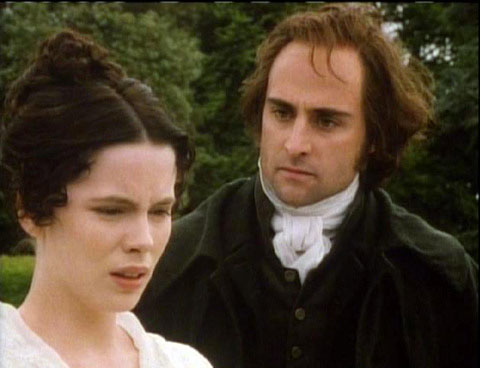
Emma and Mr. Knightley, Emma (Themed Week Day 1)

Today begins my themed week, in which I talk about one 'love story' each day for the next five days, and generally offer my thoughts on why they work/don't work, why I love or don't love the characters, and so forth. I always love your comments, and you're all amazing with them, so please do keep them coming!


So today I'm going to talk about Emma and Mr. Knightley from Jane Austen's Emma. Most people will wonder why I've skated over Darcy and Elizabeth, but, quite frankly, I'm a bit bored of them. 

I actually surprised myself when I chose this pair, mostly because I don't like Jane Austen much (sorry, Austen fans). That said, I always thought there was a certain charm and appeal to the Emma/Knightley love story and I decided it was worth talking about in terms of the way it's portrayed and executed.


First, a snapshot-


EMMA
I'm such a good matchmaker, I'm totally going to keep doing it.

MR. KNIGHTLEY
Emma, you're going to be sorry you meddled.

EMMA
I'm going to meddle.

MR. KNIGHTLEY
Emma, look at what you've done! You're a spoiled, selfish cow.

EMMA
Oh, no, look at what I've done. I'm a spoiled, selfish cow.

MR. KNIGHTLEY
I told you so.

EMMA
Oh, I have seen the error of my ways! And now my dear friend loves my other dear friend, but I love my second dear friend. Oh, woe, what shall I do? How did I mistake this love all my long years?

MR. KNIGHTLEY
Chill out, Em. I love you too.

EMMA
*swoons*


Tongues and cheeks aside, this has become a classic story. Girl/boy has a Best Friend or Close Older Friend of the opposite sex, develops a crush on someone else, realizes this isn't true love, and ultimately realizes that True Love has always existed in the form of said Best Friend or Close Older Friend. Often, Best Friend or Close Older Friend will be the moral compass by which Girl/Boy makes tough choices, and will be the one to point out Girl/Boy's mistakes when they go astray and bring them back onto the path of What is Right, Good, and Generally All Those Soppy Kinds of Things.

What really worked in Emma can be boiled down to two reasons:

First, the value of the love story between the flawed character and the true friend who makes them better, but also loves them in spite of their flaws. I think this appeals to us on a most basic level. Whatever her flaws (many readers don't even like Emma), there's something intensely comforting, romantic and sweet about knowing that there is somebody who points out her flaws, steers her the right way, but also loves her unconditionally.

It's what we want, isn't it? We see Mr. Knightley accept and love Emma and we think, yes, we're flawed too. Okay, maybe we're not meddling in everybody's blinking lives, but we're all flawed. But that doesn't mean we won't be loved for exactly what and who we are.

Secondly, there's the twist. Readers like being tricked, as long as there's a pay-off, a safety net that still maintains the trust between author and reader. For instance, if we spend half a book being conned into believing that the main character is a human being (deliberate human characteristics, personality, etc), only to find out at the end that he/she is a cat, we're going to be a little pissed off. That's when the trick has no safety net and we feel betrayed by the author.

But when, as in any good detective fiction, we are shown certain things that lead us to one conclusion (rather than being told them) only to discover the answer is different but the clues were there all along, we feel thrilled. We've been tricked but caught, and it's brilliant.

Austen sort of does that. Dipping into Emma's head, we live the story through her lack of knowledge of her own feelings. Rather than being told that Emma feels this way, we are shown it, and when she discovers she was wrong and blind about her feelings, we understand and feel the same way too. We are led along with the character, tricked just as she was tricked by her own self. 

The twist amps up the tension and excitement in the story, and ultimately the pay off too. Believing that things had gone badly wrong, as Emma does, we are thrilled with the happy ending. 

What this sort of says to me, as a writer and reader, is that playing with a reader's expectations, if done right, really, really works.

Having said that, it's interesting that most readers who pick Emma up for the first time these days go into it knowing that she and Mr. Knightley are going to end up together. I mean, it's general knowledge, isn't it? And I think this foreknowledge lends a different appeal to the book. It's like reading your favourite mystery for a second time, and feeling excited as you see the clues and go 'yes! There it is!'

So to add that up, it's essentially Being Loved For Who You Are + Well-Executed Twist = Great Love Story. A healthy dose of humour doesn't go amiss, either.

What makes this relationship somehow more appealing than many others using the same formula is the realism in Austen's prose. While dry and obviously intended to be ironic on many levels, Austen does fit into the realism of the times. This leaves us with the impression of a very down-to-earth, plausible relationship that doesn't at any point ask us to suspend disbelief. As much as we adore the sparkly vampires and sexy werewolves of our paranormal-infested culture, none of us really believe we'll find an Edward Cullen. Heck, many of us don't want one. Many of us want a George Knightley instead.

How do you feel about Emma? Do you think the above formula makes for a great story or memorable love story, if done right?

While you ponder that, my dears, I'm just going to be hiding from all those Edward Cullen fans...