
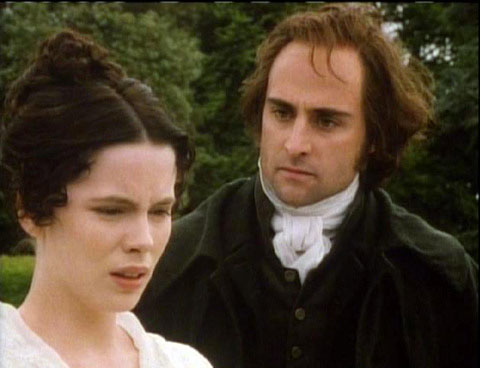
So today I'm going to talk about Emma and Mr. Knightley from Jane Austen's Emma. Most people will wonder why I've skated over Darcy and Elizabeth, but, quite frankly, I'm a bit bored of them.
I actually surprised myself when I chose this pair, mostly because I don't like Jane Austen much (sorry, Austen fans). That said, I always thought there was a certain charm and appeal to the Emma/Knightley love story and I decided it was worth talking about in terms of the way it's portrayed and executed.
First, a snapshot-
EMMA
I'm such a good matchmaker, I'm totally going to keep doing it.
MR. KNIGHTLEY
Emma, you're going to be sorry you meddled.
EMMA
I'm going to meddle.
MR. KNIGHTLEY
Emma, look at what you've done! You're a spoiled, selfish cow.
EMMA
Oh, no, look at what I've done. I'm a spoiled, selfish cow.
MR. KNIGHTLEY
I told you so.
EMMA
Oh, I have seen the error of my ways! And now my dear friend loves my other dear friend, but I love my second dear friend. Oh, woe, what shall I do? How did I mistake this love all my long years?
MR. KNIGHTLEY
Chill out, Em. I love you too.
EMMA
*swoons*
Tongues and cheeks aside, this has become a classic story. Girl/boy has a Best Friend or Close Older Friend of the opposite sex, develops a crush on someone else, realizes this isn't true love, and ultimately realizes that True Love has always existed in the form of said Best Friend or Close Older Friend. Often, Best Friend or Close Older Friend will be the moral compass by which Girl/Boy makes tough choices, and will be the one to point out Girl/Boy's mistakes when they go astray and bring them back onto the path of What is Right, Good, and Generally All Those Soppy Kinds of Things.
What really worked in Emma can be boiled down to two reasons:
First, the value of the love story between the flawed character and the true friend who makes them better, but also loves them in spite of their flaws. I think this appeals to us on a most basic level. Whatever her flaws (many readers don't even like Emma), there's something intensely comforting, romantic and sweet about knowing that there is somebody who points out her flaws, steers her the right way, but also loves her unconditionally.
It's what we want, isn't it? We see Mr. Knightley accept and love Emma and we think, yes, we're flawed too. Okay, maybe we're not meddling in everybody's blinking lives, but we're all flawed. But that doesn't mean we won't be loved for exactly what and who we are.
Secondly, there's the twist. Readers like being tricked, as long as there's a pay-off, a safety net that still maintains the trust between author and reader. For instance, if we spend half a book being conned into believing that the main character is a human being (deliberate human characteristics, personality, etc), only to find out at the end that he/she is a cat, we're going to be a little pissed off. That's when the trick has no safety net and we feel betrayed by the author.
But when, as in any good detective fiction, we are shown certain things that lead us to one conclusion (rather than being told them) only to discover the answer is different but the clues were there all along, we feel thrilled. We've been tricked but caught, and it's brilliant.
Austen sort of does that. Dipping into Emma's head, we live the story through her lack of knowledge of her own feelings. Rather than being told that Emma feels this way, we are shown it, and when she discovers she was wrong and blind about her feelings, we understand and feel the same way too. We are led along with the character, tricked just as she was tricked by her own self.
The twist amps up the tension and excitement in the story, and ultimately the pay off too. Believing that things had gone badly wrong, as Emma does, we are thrilled with the happy ending.
What this sort of says to me, as a writer and reader, is that playing with a reader's expectations, if done right, really, really works.
Having said that, it's interesting that most readers who pick Emma up for the first time these days go into it knowing that she and Mr. Knightley are going to end up together. I mean, it's general knowledge, isn't it? And I think this foreknowledge lends a different appeal to the book. It's like reading your favourite mystery for a second time, and feeling excited as you see the clues and go 'yes! There it is!'
So to add that up, it's essentially Being Loved For Who You Are + Well-Executed Twist = Great Love Story. A healthy dose of humour doesn't go amiss, either.
What makes this relationship somehow more appealing than many others using the same formula is the realism in Austen's prose. While dry and obviously intended to be ironic on many levels, Austen does fit into the realism of the times. This leaves us with the impression of a very down-to-earth, plausible relationship that doesn't at any point ask us to suspend disbelief. As much as we adore the sparkly vampires and sexy werewolves of our paranormal-infested culture, none of us really believe we'll find an Edward Cullen. Heck, many of us don't want one. Many of us want a George Knightley instead.
How do you feel about Emma? Do you think the above formula makes for a great story or memorable love story, if done right?
While you ponder that, my dears, I'm just going to be hiding from all those Edward Cullen fans...

